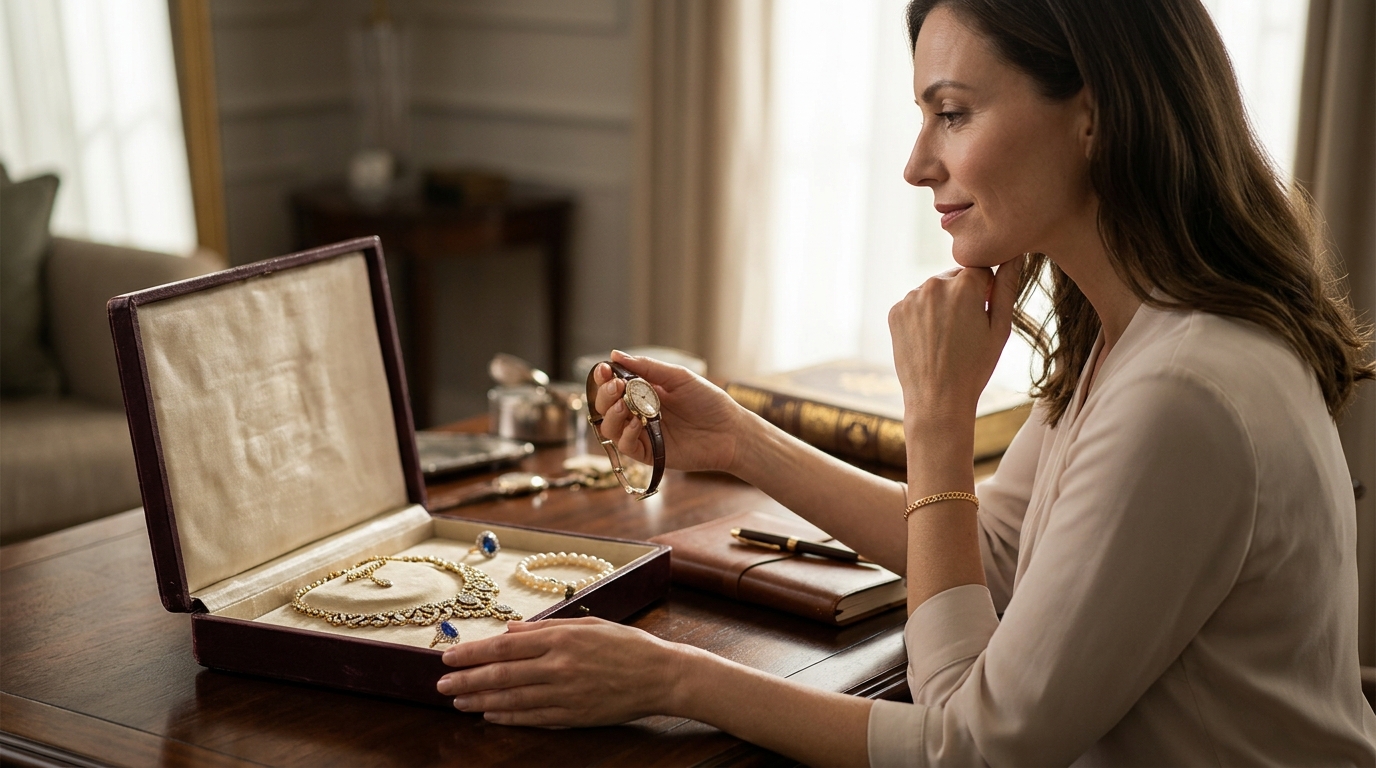
Inherited jewelry can represent much more than its weight in gold. A ring from a family estate may contain a valuable diamond, a collectible designer signature, a desirable vintage style, or a rare gemstone that deserves individual consideration. At the same time, some pieces are worth primarily for their precious-metal content. The challenge is determining which category your jewelry belongs to before accepting an offer.
The safest approach is to organize the pieces, preserve any documentation, avoid unnecessary repairs, and have the jewelry examined by a reputable buyer who can explain how the offer was calculated. This guide walks through the most important questions to ask when selling estate jewelry, whether you are located in Lake Worth, Wellington, West Palm Beach, Palm Beach Gardens, or another Palm Beach County community. You can also review feedback from local customers before choosing where to begin: read Lake Worth Gold Mine customer reviews.
1. Start by understanding what “estate jewelry” means
“Estate jewelry” generally refers to previously owned jewelry. It does not necessarily mean the item is antique, and it does not automatically indicate a high value. Estate jewelry may include recently purchased gold, vintage costume pieces, antique diamond rings, signed designer jewelry, watches, coins, or items inherited after someone’s passing.
Age is only one part of the evaluation. A modern 18-karat designer bracelet may be more desirable than an older but unbranded piece. Conversely, an apparently simple brooch may contain an unusual gemstone or carry historical significance. Instead of assuming that every item should be valued as scrap, ask the buyer to evaluate three possible sources of value:
- Material value: the amount and purity of gold, silver, platinum, or other precious metal.
- Gemstone value: the quality, size, rarity, origin, treatment, and documentation of the stones.
- Market or collectible value: the brand, design period, craftsmanship, condition, rarity, and current demand.
2. Sort the collection before you go to a buyer
Before placing everything in a bag, make a basic inventory. Group rings, earrings, necklaces, bracelets, brooches, watches, loose stones, and boxes separately. Photograph distinctive pieces and write down anything you already know, such as the name of the person who owned it, where it was purchased, or whether it was worn regularly.
This preparation helps prevent valuable items from being overlooked. It also gives you a chance to find matching earrings, detachable pendants, watch papers, jewelry boxes, insurance appraisals, receipts, or laboratory reports. Do not discard pieces simply because they are damaged. A broken chain may still contain valuable gold, and a ring with a worn setting may contain a valuable diamond.
3. Check metal markings, but treat hallmarks as a starting point
Look for markings in common locations: inside a ring shank, on the clasp of a chain, on the back of a pendant, or inside a watch case. Typical gold marks include 10K, 14K, 18K, and 24K. Because karat describes the proportion of pure gold in the alloy, 18K contains more gold than 14K, while 10K contains less. Silver may be marked 925 or Sterling, and platinum may use marks such as PT, Plat, or numerical fineness designations.
Markings are useful clues, but a stamp is not a substitute for professional testing. Estate jewelry may have worn, altered, counterfeit, or incomplete marks. Gold-plated, gold-filled, and mechanically bonded items can look similar to solid gold while containing a different amount of precious metal. The Federal Trade Commission explains that precious-metal descriptions and karat disclosures should accurately communicate what a jewelry item contains. ([ftc.gov](https://www.ftc.gov/news-events/topics/tools-consumers/jewelry-guides?utm_source=openai))
A reputable buyer should confirm the metal using appropriate testing and should explain whether an offer is based on solid precious-metal content, gemstone resale potential, designer value, or a combination of factors. Ask whether stones, nonprecious components, and settings are included in the quoted weight.
4. Protect the value of diamonds and colored gemstones
Do not assume that a heavy gold setting tells the whole story. A diamond or colored gemstone may contribute most of the value. For diamonds, the standard evaluation framework is the Four Cs: cut, color, clarity, and carat weight. GIA describes these characteristics as the foundation for consistent diamond-quality assessment, and a grading report can provide an impartial description of a stone’s documented quality. ([4cs.gia.edu](https://4cs.gia.edu/en-us/how-to-buy-a-diamond/?utm_source=openai))
For colored gemstones, buyers may consider whether the stone is natural, laboratory-created, or imitation; whether it has been heated, filled, dyed, or otherwise treated; its color and clarity; its size; and its overall rarity. Rubies, sapphires, emeralds, tourmalines, and other stones do not all use the same grading system as diamonds.
Keep laboratory reports with the jewelry whenever possible. Do not remove a diamond or gemstone from its setting before an evaluation unless a qualified professional recommends it. Removing a stone can damage the mounting, create confusion about the original piece, and expose the gem to loss or accidental damage. A buyer can often conduct an initial examination while the stone remains mounted.
5. Gather brand information and provenance
Designer jewelry can have a resale market that extends beyond metal and gemstone weight. Names such as Cartier, Tiffany & Co., Van Cleef & Arpels, Chanel, David Yurman, Bulgari, and other recognized houses may attract collectors, but the brand must be authenticated. Look for logos, maker’s marks, serial numbers, date codes, model references, signatures, and country-of-origin stamps.
Collect any original receipt, certificate, appraisal, service record, presentation box, pouch, or family documentation. These items do not guarantee authenticity or a particular price, but they can help establish ownership history and make it easier for a buyer to research the piece. Missing packaging does not make jewelry unsellable; an item can still be evaluated by its construction, markings, materials, condition, and authenticity.
Be cautious about making an expensive repair solely to increase the sale price. A repair may improve the item’s appeal, but the cost is not always recovered. Ask a buyer or independent jewelry professional whether restoration is likely to add more value than it costs.
6. Evaluate condition, originality, and repair needs
Condition affects both collectible value and the buyer’s expected cost of resale. Examine the piece for missing stones, bent prongs, broken clasps, deep dents, thinning bands, stretched links, cracked enamel, discoloration, and signs of previous resizing. Normal surface wear is common in older jewelry and does not automatically make a piece undesirable. In fact, some antique pieces are valued for their original finish and period character.
Avoid polishing, acid testing, aggressive ultrasonic cleaning, or do-it-yourself tightening before the evaluation. These actions can scratch delicate metals, loosen stones, remove patina, or damage fragile antique construction. A soft cloth may remove surface dust, but professional cleaning and inspection are usually safer for valuable or unfamiliar pieces.
Tell the buyer about known damage, previous repairs, replaced stones, or alterations. Accurate disclosure helps the evaluator determine whether the item should be marketed as wearable jewelry, restored, sold as a collectible, or valued primarily for its precious-metal content.
7. Know the difference between an appraisal and an offer
People often use the words “appraisal” and “value” as if they mean the same thing, but different valuations serve different purposes. An insurance appraisal may estimate replacement cost. An estate or tax valuation may address fair market value for a specific date. A resale offer reflects what a buyer can reasonably pay based on current metal markets, expected repair costs, demand, authentication risk, and the buyer’s ability to resell or refine the item.
Gold, silver, and platinum prices can change, so the material portion of an offer is time-sensitive. However, market price is not the only factor. A buyer must also determine purity, net precious-metal weight, gemstone quality, brand authenticity, and the likely market for the finished piece.
If you receive a written appraisal from another professional, bring it to the buyer and ask how it relates to the proposed purchase price. A high replacement value does not necessarily mean a buyer will pay that amount in a direct resale transaction.
8. Compare buyer types before choosing where to sell
The most appropriate buyer depends on what you own and how quickly you want to complete the transaction. Consider the following options:
| Buyer type | Potential advantage | Important question |
|---|---|---|
| Specialized jewelry or estate buyer | Can evaluate precious metals, gemstones, watches, designer items, and collectible pieces in one visit | Will the evaluation happen in front of me, and will the offer explain each value component? |
| Pawn shop | Fast transaction and possible loan option | Am I receiving an outright purchase offer or borrowing against the item? |
| Online mail-in service | Convenient for some sellers who cannot travel | How is the item insured, documented, valued, and returned if I decline the offer? |
| Auction or consignment business | May reach collectors seeking a particular designer or period | What are the commission, reserve, timeline, and payment terms? |
For a mixed estate collection, an in-person specialist can be especially convenient because gold, diamonds, watches, coins, and designer jewelry may each require a different type of evaluation. Avoid comparing only the headline percentage or advertised “top dollar” claim. Compare the final net amount, fees, turnaround time, security procedures, and clarity of the explanation.
9. Prepare for a safe and transparent evaluation
Before visiting a buyer, call to confirm hours, whether an appointment is recommended, and what identification or ownership documentation may be required. Bring the jewelry, supporting papers, and any prior appraisal or receipt that may help establish provenance.
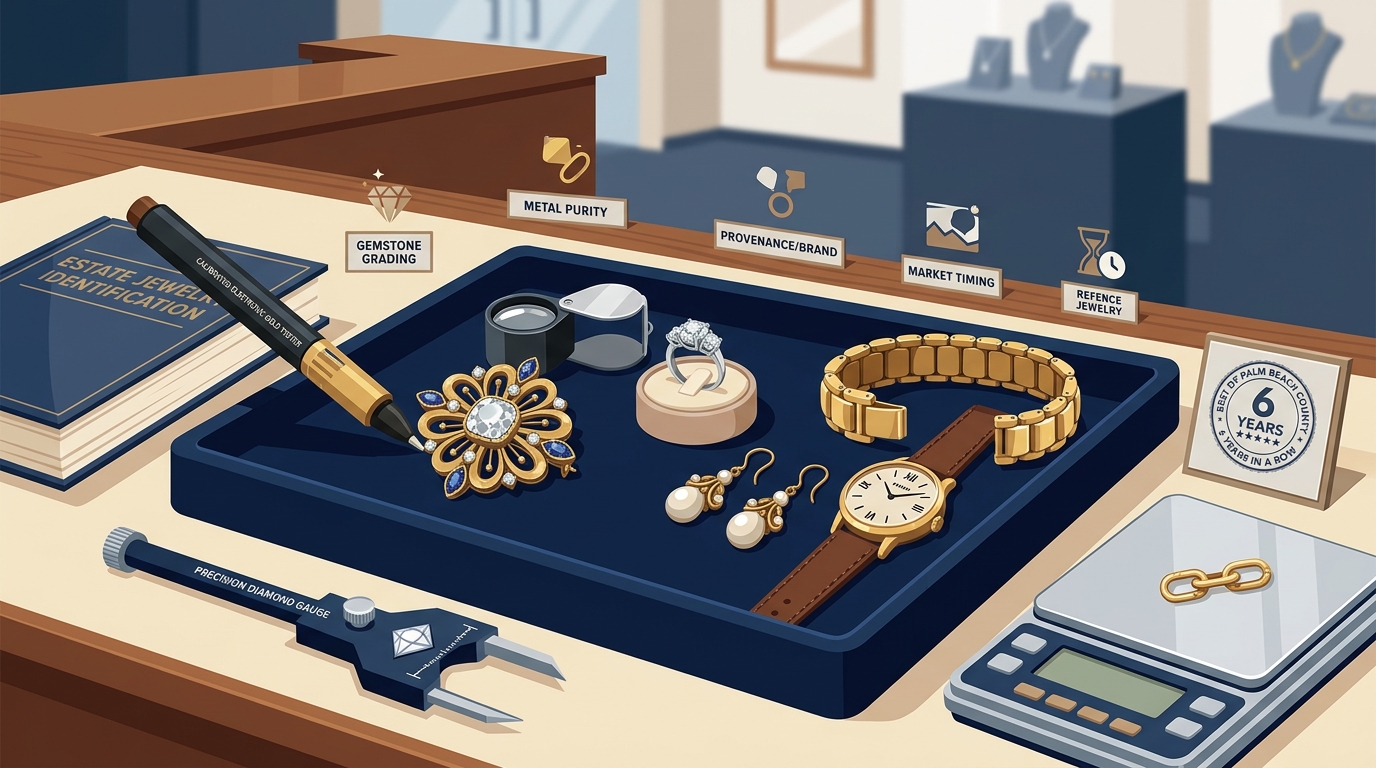
During the evaluation, look for a process that is observable and understandable. Depending on the item, the buyer may:
- Separate pieces by metal type and karat.
- Weigh items on an appropriate scale.
- Test metal purity using suitable methods.
- Inspect gemstones under magnification.
- Check designer marks, serial numbers, and construction details.
- Discuss repair, refining, resale, or collector considerations.
- Provide the offer and payment terms before you make a decision.
You should not feel pressured to accept immediately. Ask whether the offer is for the entire group or for individual items, whether any fees will be deducted, and what form of payment is available. A secure standalone store and an in-person evaluation can make the process more comfortable than shipping sentimental or high-value jewelry to an unknown destination.
Why local Palm Beach County sellers choose an in-person evaluation
For residents near Lake Worth, Wellington, West Palm Beach, and Palm Beach Gardens, a local visit allows you to keep control of the jewelry while questions are answered face to face. Lake Worth Gold Mine evaluates gold jewelry, scrap gold, silver, diamonds, coins, watches, designer jewelry, handbags, estate jewelry, collectibles, sports cards, and memorabilia. Visit the Lake Worth Gold Mine homepage to learn more about the store and request an evaluation.
Key takeaways
- Do not judge estate jewelry by age or appearance alone. Material, gemstones, brand, condition, rarity, and demand can all affect the result.
- Use hallmarks as clues, not proof. Professional testing is important because stamps may be worn, incomplete, or misleading.
- Preserve paperwork and packaging. Reports, receipts, boxes, service records, and ownership history may help authenticate designer or gemstone jewelry.
- Leave risky cleaning and repairs to professionals. DIY work can damage antique settings or remove desirable original finishes.
- Keep valuation types separate. Insurance replacement cost is not the same as a direct-sale offer.
- Compare the net transaction. Ask about fees, timing, payment, security, and whether the offer is itemized.
- Choose a buyer equipped for the whole collection. A specialist may be able to evaluate gold, diamonds, watches, coins, and designer pieces together.
Frequently asked questions about selling estate jewelry
How do I know whether inherited jewelry is valuable?
Begin by looking for precious-metal marks, gemstone reports, designer signatures, serial numbers, and unusual construction. Weight alone is not enough. A professional evaluation can determine whether the piece has scrap, gemstone, designer, antique, or collector value.
Should I get an appraisal before selling estate jewelry?
An appraisal may be useful when you need documentation for insurance, an estate settlement, taxes, or family distribution. For a direct sale, however, the appraisal’s purpose matters. Ask whether it represents replacement cost, fair market value, or another valuation standard, because it may not equal the amount a buyer can offer today.
Is estate jewelry worth more than its gold weight?
Sometimes. Designer branding, a desirable period, a well-cut diamond, a rare natural gemstone, excellent condition, or strong collector demand may increase value above melt value. Unbranded, damaged, incomplete, or heavily worn pieces may be valued primarily for their metal content.
Can I sell jewelry without the original box or receipt?
Yes. Original packaging and receipts can help with provenance, especially for designer pieces, but they are not required for an evaluation. The buyer can examine the jewelry’s markings, construction, materials, condition, and any available documentation.
Should I clean antique jewelry before bringing it to a buyer?
Use caution. A gentle wipe with a soft cloth is usually enough to remove surface dust, but avoid harsh chemicals, polishing compounds, ultrasonic cleaners, and home repairs. Antique settings and original patina can be delicate or valuable.
How are diamonds evaluated when they are mounted in jewelry?
A buyer can often inspect a mounted diamond with magnification and testing equipment. The evaluation may be more limited than a full laboratory grading report, but removing the stone is not always necessary. Do not have a stone removed unless a qualified professional explains why it is appropriate.
What should a transparent jewelry buyer explain?
The buyer should explain the metal type and purity, relevant weight, gemstone or designer considerations, condition issues, deductions or fees, payment method, and whether the offer is for individual items or the collection as a whole. You should be able to ask questions and make your decision without pressure.
How long does an in-person estate jewelry evaluation take?
The time depends on the size and complexity of the collection. A small group of common gold items may be evaluated quickly, while designer jewelry, diamonds, watches, coins, and unusual collectibles require more inspection. Ask the store about expected timing before your visit.
Ready to have your estate jewelry evaluated?
The best first step is an organized, informed evaluation—not a rushed decision based on a single number. Gather the jewelry and related documents, keep the pieces in their current condition, and choose a buyer who can explain how metal, gemstones, brand, condition, and market demand affect the offer.
Lake Worth Gold Mine provides in-person evaluations for sellers in Palm Beach County, including gold, silver, diamonds, watches, coins, designer jewelry, and estate pieces. Visit Lake Worth Gold Mine to learn more and arrange your next step.
Related resources
- 1. Verify Metal Purity and Hallmarks
- 2. Assess Gemstone Quality and Certification
- 3. Identify Designer Brand Provenance
- 4. Evaluate Condition and Aesthetic Integrity
- 5. Analyze Current Market Demand
- 6. Choose the Right Buyer Type
- 7. Ensure Transparent Transaction Security
- Frequently Asked Questions
- Ready to Sell Your Estate Jewelry?