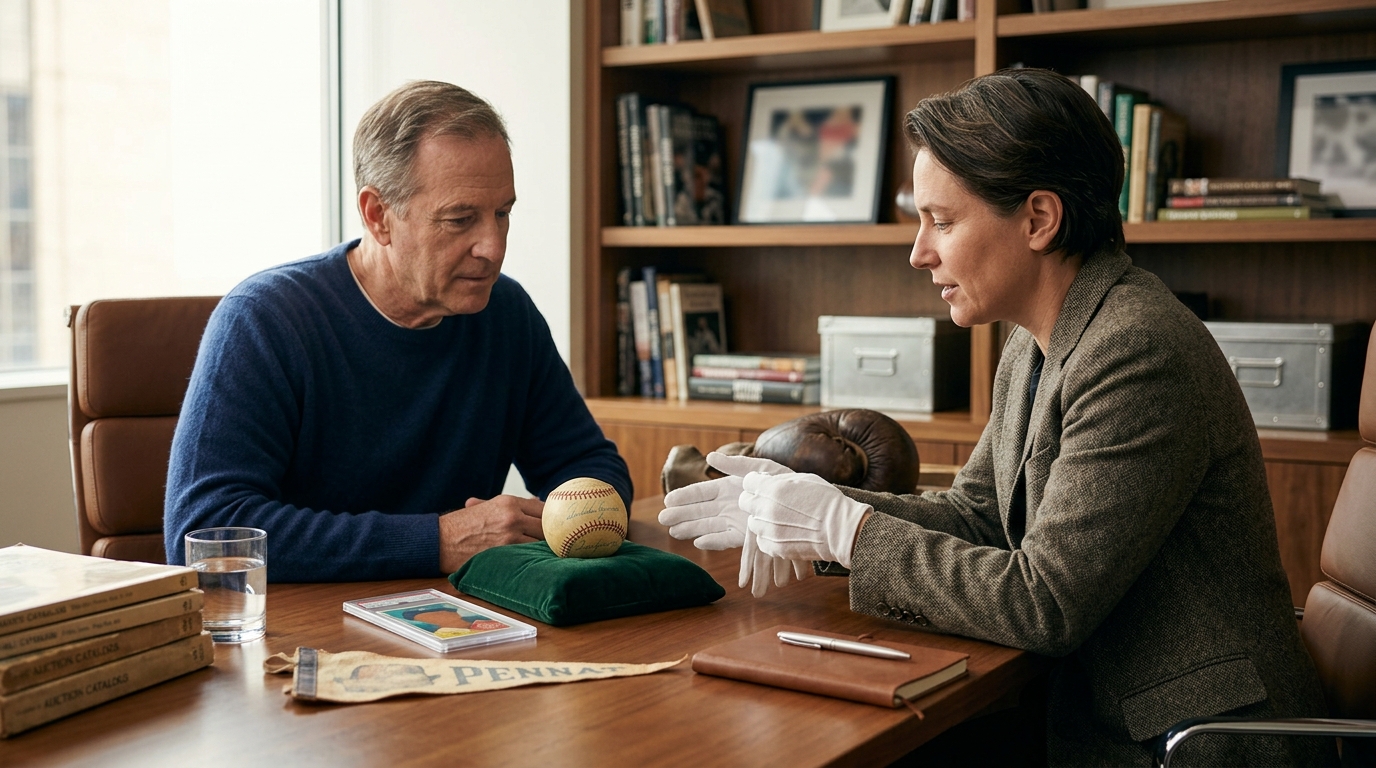
Selling sports memorabilia can be straightforward when you work with a buyer who understands authentication, condition, provenance, market demand, and secure transactions. It can also become expensive when an item is misidentified, an autograph is treated as genuine without adequate evidence, or a buyer gives a vague offer without explaining how it was calculated.
Whether you inherited a collection, are downsizing, or want to turn sports cards and memorabilia into cash, the safest approach is to evaluate the buyer as carefully as the buyer evaluates your items. A reputable local dealer should explain what affects value, distinguish collectible premiums from ordinary resale value, document the transaction, and let you make an informed decision without pressure.
For sellers in Lake Worth, Wellington, West Palm Beach, Palm Beach Gardens, and surrounding Palm Beach County communities, a local, stand-alone store can offer an important advantage: you can meet the buyer in person, bring related items together, ask questions, and receive a clear offer without shipping your collection to an unknown business.
1. Create a Basic Inventory Before Contacting Buyers
You do not need to be a professional collector to prepare your collection. A simple inventory helps a buyer evaluate the items efficiently and helps you avoid overlooking something valuable.
Record the details that identify each item
- Player, team, league, or event
- Item type, such as trading card, signed jersey, baseball, photograph, ticket, game-used equipment, or championship memorabilia
- Year, manufacturer, set, card number, or edition when applicable
- Whether the item is signed, numbered, limited, rookie-related, game-used, or accompanied by a certificate
- Condition, including creases, fading, stains, tears, scratches, dents, or damaged packaging
- Any known purchase history, family history, auction record, or previous ownership information
For sports cards, identification details such as year printed, manufacturer, set, player, card number, and parallel or variation can materially change the result of a price search. PSA also recommends reviewing a card’s surface, edges, corners, centering, and signs of damage when considering condition and grading. Authentication confirms that a card is genuine; grading evaluates its condition on a numerical scale. ([psacard.com](https://www.psacard.com/services/authentication?utm_source=openai))
Keep paperwork and accessories together
Do not separate certificates of authenticity, original receipts, ticket stubs, team letters, photographs of the item in use, auction invoices, or manufacturer packaging from the memorabilia. Documentation does not automatically prove authenticity, but it can provide useful context and may reduce the amount of research needed before a buyer makes an offer.
Place cards in protective sleeves and rigid holders, keep autographed items away from heat and moisture, and avoid cleaning, ironing, trimming, repainting, or otherwise altering collectibles before an evaluation. An attempted repair can reduce buyer confidence and may affect authentication.
2. Understand What Authentication and Grading Actually Do
Authentication and grading are related but different services. Authentication asks whether an item is genuine. Grading assesses condition, quality, or presentation after the item has passed an authenticity review. A trusted buyer should be able to explain which question applies to each part of your collection.
Trading cards
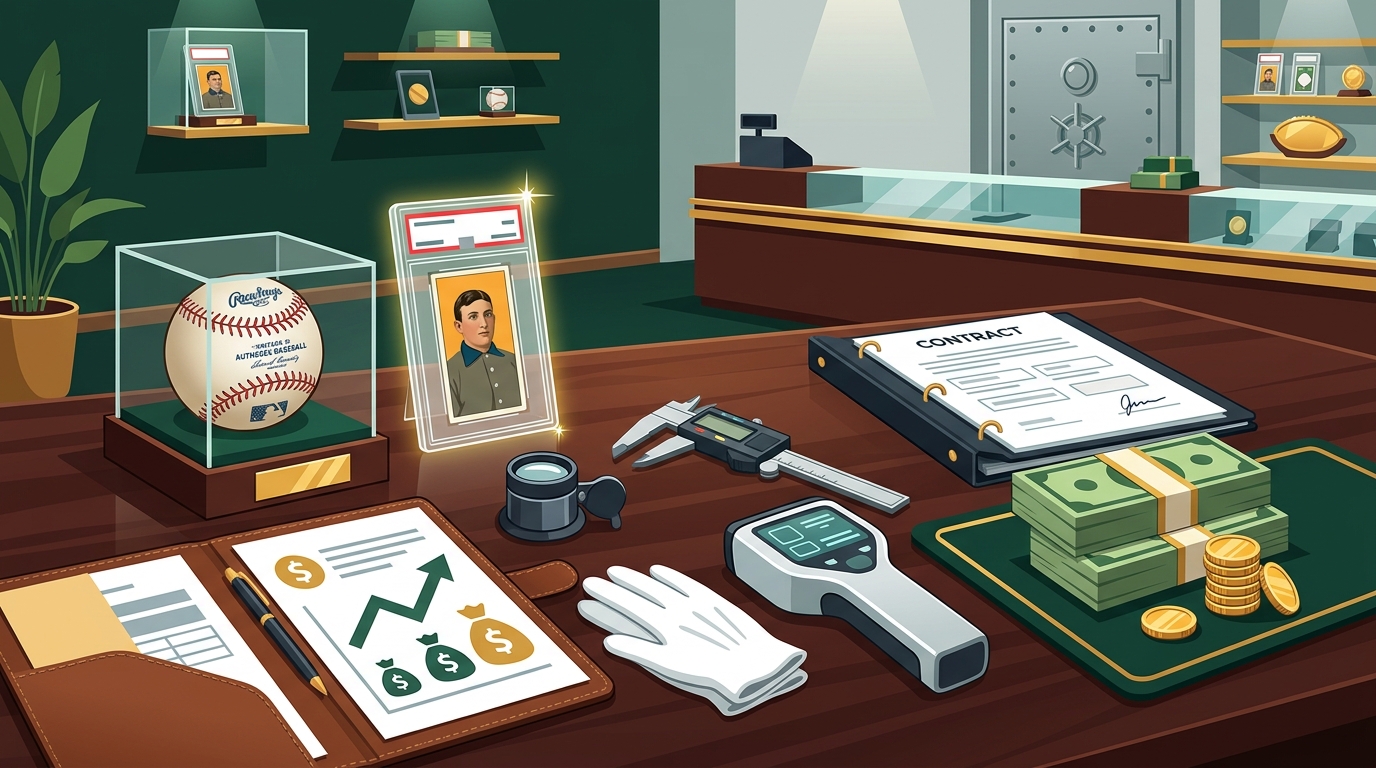
For cards, professional grading can establish a recognizable condition standard and place the item in a tamper-evident holder. PSA describes its process as authentication first, followed by grading and encapsulation if the card qualifies. Its services cover sports cards and other collectible cards, with a certification number that can be checked through its verification resources. ([psacard.com](https://www.psacard.com/services/authentication?utm_source=openai))
Grading is not automatically worthwhile for every card. Submission fees, shipping, insurance, turnaround time, declared value, and the likelihood of receiving a desirable grade should be weighed against the card’s expected selling price. A knowledgeable buyer can often help you decide whether a card should be sold raw, submitted for grading, or researched further.
Autographs and signed memorabilia
Signatures are affected by the athlete, item type, quality of the autograph, location of the signature, condition, and strength of the supporting documentation. PSA states that autograph authentication can include ink analysis, autograph-structure analysis, object evaluation, and side-by-side comparisons, with certification information available for verification. ([psacard.com](https://www.psacard.com/services/autographauthentication/authentication?utm_source=openai))
Be cautious when a seller’s only proof is a generic paper certificate from an unknown source. A trusted buyer should not dismiss authentication concerns simply because a signature looks familiar. The buyer should explain whether the item has recognized third-party authentication, credible provenance, or needs additional review.
Game-used and photo-matched items
Game-used jerseys, bats, gloves, helmets, balls, and equipment may require more than an autograph review. Details such as team-issued tags, uniform style, player usage, manufacturing characteristics, photographs, and documented chain of ownership can matter. PSA describes photo matching as research that can identify visual characteristics connecting an item to a documented game or player and may result in a verifiable certificate. ([psacard.com](https://www.psacard.com/services/memorabilia?utm_source=openai))
A responsible buyer will separate “signed” from “game-used,” “team-issued” from “game-worn,” and “similar to a known example” from “documented to a specific event.” Those distinctions help prevent unrealistic expectations.
3. Research Realistic Market Prices Before Accepting an Offer
Online asking prices are not the same as completed sale prices. A card listed for $500 may remain unsold, while comparable examples in different grades may sell for very different amounts. Before meeting a buyer, search for completed auction results and compare items that truly match yours.
Use comparable sales carefully
When researching, match as many variables as possible:
- Exact year, set, variation, and card number
- Professional grade and certification company
- Autograph authentication status
- Condition and completeness
- Game-used or event-specific documentation
- Sale date and venue
- Whether the price includes a buyer’s premium or other fees
Use established auction archives and collector price databases as research tools, then treat the results as a range rather than a guaranteed payout. A dealer’s offer must account for authentication risk, overhead, resale time, market demand, and the cost of preparing the item for sale. The highest visible online price is rarely a reliable estimate of what a local dealer can pay immediately.
For a broader view of collecting, valuation, and precious-metal-related topics, you can also review the Lake Worth Gold Mine blog. If your collection includes coins, bullion, or medals, make sure the buyer can distinguish collectible or numismatic value from metal content. The Lake Worth Gold Mine coin store resource may also be useful when organizing mixed collections.
4. Screen the Buyer’s Reputation, Expertise, and Business Location
A trusted buyer should be easy to identify and willing to answer reasonable questions. Before bringing in high-value items, review the business’s history, customer feedback, store location, and areas of expertise.
Look for evidence of an established operation
- A verifiable physical storefront
- Consistent business name, address, and contact information
- Detailed customer reviews across reputable platforms
- Clear information about the categories purchased
- Staff who can explain the evaluation process without using confusing jargon
- Written receipts or purchase documentation
- A history of serving the local community
Read reviews for recurring patterns instead of focusing on one unusually positive or negative comment. Look for comments about communication, fairness, professionalism, wait times, and whether customers understood the final terms. You can review Lake Worth Gold Mine customer reviews as one example of the type of local reputation information a seller can examine.
Recognition such as “Best of Palm Beach County” can be a positive trust signal, but it should be considered alongside current reviews, transparent policies, and the quality of the in-person evaluation. Awards alone do not replace due diligence.
Ask the buyer direct questions
Before agreeing to sell, ask:
- How do you determine the offer for this item?
- Do you authenticate in-house, use a third party, or rely on existing certification?
- Do you buy outright, offer consignment, or do both?
- Are there any appraisal, processing, shipping, or administrative fees?
- When and how would I be paid?
- Will I receive an itemized receipt?
- What happens if you discover an issue after preliminary inspection?
A reputable buyer may not be able to give a final figure until the item is examined in person, but should still be able to describe the factors being considered.
5. Compare Offers Beyond the Headline Dollar Amount
Obtaining more than one opinion is sensible, particularly for rare cards, signed items, vintage collections, championship pieces, and game-used equipment. Three offers can provide a useful comparison, although the quality of the evaluation matters as much as the number of quotes.
Compare the complete terms
| Question | Why it matters |
|---|---|
| Is this an outright purchase or consignment? | An outright purchase provides faster certainty; consignment may produce a higher gross price but usually involves waiting and commissions. |
| Are fees deducted? | A higher quoted price may not be better if undisclosed costs reduce your net payment. |
| When is payment made? | Payment timing affects convenience and risk, especially when an item is shipped or held for additional review. |
| What condition or authenticity assumptions were used? | An offer based on an incorrect version, grade, or provenance may not be comparable. |
| Will the buyer provide documentation? | A written receipt helps you track what was sold and the amount paid. |
For many sellers, a direct sale to a reputable local dealer offers a practical balance of speed, privacy, and certainty. Consignment may make sense for an especially rare item when you are prepared to wait for marketing, an auction date, a buyer, and settlement after commissions. Ask for the expected net amount, not merely the projected selling price.
6. Protect Yourself During the Sale
Valuable collectibles deserve a secure process from the first phone call through payment. If you visit a store, bring a short list of the items you want evaluated and avoid displaying the entire value of your collection unnecessarily in public.
Safeguards for an in-person transaction
- Use a professional, established location rather than an isolated meeting place.
- Keep high-value items in protective cases during transport.
- Ask to see how the item will be examined and whether it remains in your sight.
- Do not hand over unrelated valuables while discussing one item.
- Review the offer and receipt before signing or accepting payment.
- Confirm the payment amount and method before leaving.
Safeguards for an online transaction
Online selling can expand your audience, but it also adds shipping, identity, payment, and return risks. Verify the buyer’s business identity independently, use insured and trackable shipping, require signature confirmation for high-value packages, photograph the item and packaging, and retain all communications. Never rely on an unverified payment screenshot or send valuable memorabilia through ordinary untracked mail.
Be especially cautious if a buyer pressures you to make an immediate decision, requests unusual payment methods, asks you to pay an upfront “release” fee, refuses to provide a physical address, or changes the terms after receiving the item. If the process feels unclear, pause the transaction and seek another evaluation.
Why a Local Palm Beach County Buyer May Be the Right Choice
A local buyer can be convenient when you want a face-to-face evaluation, immediate answers, and payment without shipping a collection across the country. A stand-alone store also gives you an opportunity to assess the business environment, meet the staff, and ask how your items will be handled.
Lake Worth Gold Mine serves Palm Beach County from a location near the Florida Turnpike and Lake Worth Road and evaluates a broad range of items, including sports cards and memorabilia, coins, jewelry, diamonds, watches, designer goods, estate items, and collectibles. A mixed collection can often be reviewed in one appointment instead of being divided among unrelated buyers.
If you are ready to discuss a collection, visit the Lake Worth Gold Mine homepage for business information and contact options. Bring any certificates, receipts, protective cases, and relevant history that may help establish authenticity and value.
Key Takeaways
- Inventory first: Record the player, item type, year, set, condition, signature, certification, and provenance before requesting offers.
- Separate authentication from grading: Genuine does not necessarily mean high grade, and a high grade cannot compensate for an authenticity problem.
- Research completed sales: Compare exact or closely matched examples rather than relying on active listing prices.
- Evaluate the buyer: Look for a verifiable storefront, consistent reviews, relevant expertise, and clear explanations.
- Compare net proceeds: Review fees, commissions, payment timing, and whether the offer is a direct purchase or consignment.
- Prioritize documentation: Obtain a detailed receipt and retain records of the item, buyer, date, and amount paid.
- Trust the process: A professional buyer should welcome questions and give you time to make an informed decision.
Frequently Asked Questions
What is the first step when selling sports memorabilia?
Start by creating an inventory. Identify each item, record its condition, gather certificates and receipts, and separate cards, autographs, game-used equipment, photographs, and other categories. This makes it easier to obtain an accurate evaluation.
How can I tell whether a sports autograph is authentic?
Look for recognized third-party authentication, a verifiable certification number, and credible provenance. A trusted buyer should explain the difference between a professional authentication opinion, a generic certificate, and a seller’s unsupported claim. PSA describes autograph review as an examination that can include ink, structure, object, and comparison analysis. ([psacard.com](https://www.psacard.com/services/autographauthentication/authentication?utm_source=openai))
Should I grade my sports cards before selling them?
Not always. Grading may improve marketability for a rare or condition-sensitive card, but fees, shipping, insurance, turnaround time, and the likely grade must be considered. Ask a knowledgeable buyer whether grading is likely to increase the net value rather than assuming every card should be submitted.
Can I sell sports memorabilia that is not graded or authenticated?
Yes. Many buyers evaluate raw cards, unauthenticated autographs, jerseys, equipment, and collections. However, the buyer may account for authentication risk in the offer. Existing third-party certification and reliable provenance can make an item easier to sell and may improve its marketability.
How many offers should I get?
For ordinary items, one well-explained evaluation may be sufficient. For rare, high-value, or historically important memorabilia, obtaining two or three opinions can help establish a realistic range. Compare the net terms and the buyer’s expertise, not just the largest headline number.
What payment method should a trusted buyer use?
A reputable local transaction should clearly state the payment method and timing before the sale is completed. Depending on the business and transaction, payment may be made by cash, check, wire transfer, or another documented method. Confirm the amount, any deductions, and the receipt before handing over ownership.
Are local buyers safer than online buyers?
Local buyers are not automatically better, but a verifiable physical store lets you meet the buyer, inspect the facility, ask questions, and avoid shipping risks. Online buyers can be legitimate as well, but you should independently verify the business, use insured tracking, and understand payment and return terms.
What are warning signs that a memorabilia buyer may not be trustworthy?
Warning signs include pressure to sell immediately, vague pricing, unexplained fees, reluctance to provide a receipt, an unverifiable business address, requests for unusual upfront payments, refusal to discuss authentication, or changing terms after receiving your items. If you are uncomfortable, take your collection back and seek another opinion.
Get a Professional Evaluation for Your Collection
If you have sports cards, signed memorabilia, coins, watches, jewelry, or other collectibles in Palm Beach County, Lake Worth Gold Mine can provide a convenient local starting point for an evaluation. Organize your items, bring supporting documentation, and ask questions about how value is determined before deciding whether to sell.
Contact Lake Worth Gold Mine to learn more about bringing in your collection for review.